Why Indians Have Not
Invented Anything
How a civilization chose the inner universe over the outer.
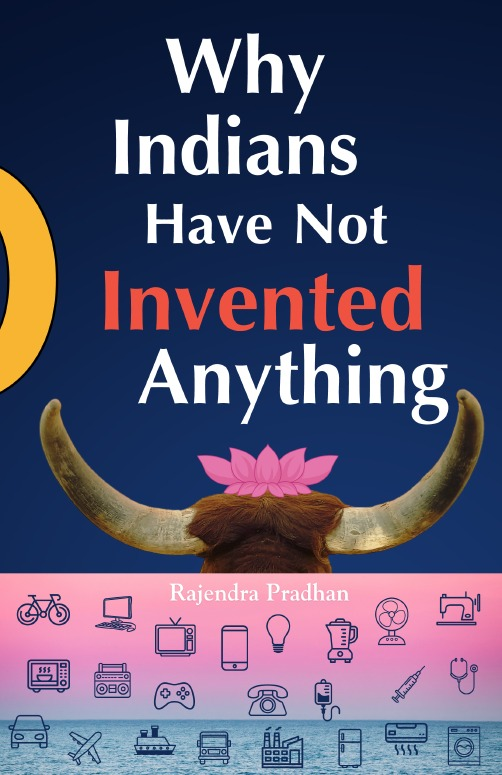
A ten-year inquiry into the question the world has been asking for two centuries.
For five hundred years the West has asked a version of the same question: why did India not industrialize, not patent, not invent? The question contains an assumption it never examines. This book examines it.
Drawing on a decade of observation of Indian daily life — the kitchen, the courtyard, the seasonal rituals — and grounded in the primary sources (the Ashtanga Hridayam, the Bhagavad Gita, the Vedas, the Upanishads, the Puranas), this is a calm, evidence-grounded reframing of one of the most provocative questions in modern thought.
Three parts. Fourteen chapters.
The Question
A child is born. For the first weeks, the child needs nothing from outside — and then food begins, and desire with it. A small story about a film, a birthday, and the question that rose up and would not leave.
Raag — The Disease Called Desire
India's oldest texts diagnose desire — raag — not as a virtue to be channeled but as a disease to be understood. The opening chapter of the book sets the diagnostic frame.
White — The Ancient Science of Equality
White contains all colors. Indian thought has, from its earliest writings, treated equality not as a political claim but as an observable property of the universe — and built a society on what follows.
Mahalakshmi — The Physics of Prosperity
Two kinds of wealth, only one of which the modern world counts. A close reading of the goddess and what she has been telling Indian households about how prosperity actually behaves.
Samudra Manthan — The Original Warning
A churning. A poison. A nectar. The oldest story India tells about invention — and the warning it has been delivering for three thousand years that the modern world has not heard.
The Cow and The Universe
The most misunderstood animal in modern India is, in the older texts, a complete cosmological model. What the cow has been teaching about systems, cycles, and completeness.
The Electricity Within You
Prana, nadi, chakra. A map of a system the modern world is now building sensors to detect — and a chapter on what to do with that map.
The Inventions You Cannot See
A civilization can invent in materials, or in attention. India chose attention. A close look at the engineering work that leaves no patent — and changes everything.
The Receiver — Aham Brahmasmi
“I am that.” The most quoted Upanishadic phrase, taken seriously as a claim about human capacity — and a chapter on what it would mean if it were true.
Born Complete
The newborn lacks nothing — and spends the rest of life, in various unconscious ways, trying to return. A chapter on what India did with that observation.
Life Within Life
The seed in the fruit in the tree in the forest. Indian thought has always reasoned in nested wholes — and a chapter on what that does to the question of invention.
The Life Cycle
Four ashramas, six ritus, twelve months, one life. The calendar India never stopped consulting, and what it knows about how a human being should be built over eighty years.
The Mirror — What Indians Think
A patient chapter on how the question looks from the inside. Not a defense. A description.
The Last Day
A civilization that knows how to end well will build differently than one that does not. India knows. A chapter on what follows from that.
Panchabhuta — The Blueprint for Future Invention
Five elements. One method. A closing chapter on what the next century of invention could look like if we let India's oldest blueprint inform it.
The Invention India Was Always Making
The closing argument. The question was never wrong. The frame was. An invitation to the reader who has come this far.
Read the Preface free
The opening pages are yours. The rest of the book is one click away.
What people are saying.
“The chapter on Mahalakshmi rewrote the way I think about wealth. I’m going to be quoting this book for years.”
Verified Amazon review
“Pradhan writes the way good elders speak. Slow. Sure. Without a hint of needing to convince you.”
Goodreads
“I have lived in India for forty years and never had it explained to me like this. I read it twice.”
Verified Amazon review