Everything a journalist needs.
Bios at three lengths, the cover, the author photo, the free chapters, and six answered interview questions. Take what's useful — no email required for any of it. Anything not here yet, just ask.
Book cover
Front cover, 502 × 775 PNG — the web edition. Ask if you need it at print resolution.
DOWNLOAD PNG · 448 KB →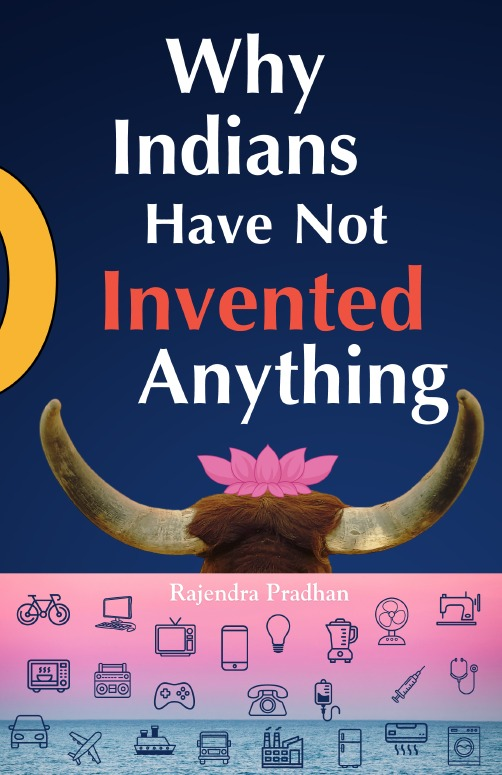
Author photo
Single portrait, 518 × 625 JPG. Ask if you need a different crop or a larger file.
DOWNLOAD JPG · 71 KB →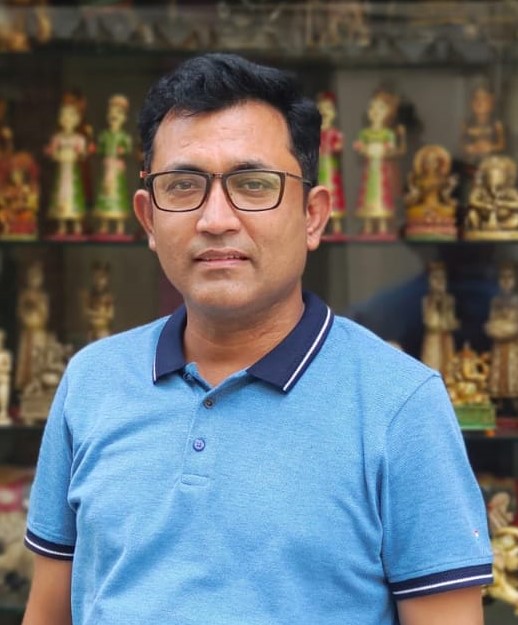
Sample chapter
The Preface and the opening of Chapter 1, free to read on this site.
READ THE PREFACE →Rajendra Pradhan is a writer from Rajasthan, India. Why Indians Have Not Invented Anything — the result of a ten-year inquiry into the question its title carries — is his first book. He lives, writes, and grows a small garden in the same town he was born in.
Rajendra Pradhan is a writer from Rajasthan, India. He spent ten years observing Indian daily life — the kitchen, the courtyard, the seasonal rituals — and listening slowly to the Indian sources these practices point back to, in translation, in practice, and in memory.
Why Indians Have Not Invented Anything is his first book. It argues, calmly and at length, that India did not fail to invent — it built a civilization to master the inner universe, at a depth no other civilization attempted. He still lives in the town he was born in.
Rajendra Pradhan is a writer from a small town in Rajasthan that has not, in any meaningful way, stopped doing what it has always done. He was born and raised there.
For most of his twenties he worked in cities. He left a job some years ago without a plan for what would replace it. In that gap a question arrived and refused to leave — the one his first book is named after. The book is the answer he was able to find. It took ten years.
Why Indians Have Not Invented Anything: How a Civilization Chose the Inner Universe Over the Outer is the result of a decade of careful observation of Indian daily life and slow listening to the Indian sources these practices point back to. It was published in 2026.
He still lives in the same town, writes in the morning, and works through the texts slowly with help from teachers who have spent their lives with them. He is not a Sanskrit scholar and does not claim to be.
01 — What is the book actually arguing?
That the question "why did India not invent?" contains an assumption the question never examines — namely that invention, in the material sense, is the only kind there is. India was working on a different problem, with a different method, on a different timescale. The book is a calm description of what that problem was.
02 — Is this a nationalist book?
No. The book is not defending anything. It is describing something. There is a meaningful difference between the two and the book takes a great deal of care to stay on the descriptive side of it.
03 — Why did it take ten years?
Because the texts are slow, the observations are slow, and the conclusions are not the kind one rushes to. I wrote in mornings, watched in afternoons, and changed my mind several times.
04 — Who is the book for?
For the reader who has heard the question and felt that the answer they were offered did not quite fit. Indian and non-Indian alike.
05 — What surprised you while writing it?
How much of what I thought I had figured out was already in my grandmother's kitchen. I had been looking at the texts to confirm what she already lived.
06 — What's next?
A podcast called Notes from Rajasthan, in which I hope to have slow conversations with readers and scholars. Nothing is recorded yet. And a second book, probably. Not for a while.
07–10 — Available in the full press kit PDF
On the comparable titles, the texts cited, and what the title is hoping to do.
Writing a piece, recording an episode, or planning an event?
Reach out directly. Reviews welcomed. Review copies sent within 48 hours.
press@whyindians.com